xTool O1 Omni Printer: Prices, Editions, and Ink Costs
xTool says 'from $1,699' for a 4-in-1 that prints on wood, tumblers, and T-shirts. That number is a deposit-locked early bird on the single-head model, and the only edition that does all four jobs is $2,799. Here's every price, the published ink costs, and what it can't do.
Contents
- What changed
- The three editions, and the one that does all four jobs
- What the $1,699 buys, and what every edition shares
- It prints 7 mm of texture, not 3D models
- What the ink actually costs
- The running costs to budget for
- xTool O1 Omni vs eufyMake E1 vs HeyGears G1
- Which edition, and should you wait
- How the $50 deposit works
- What's still unknown
- Frequently asked questions
xTool opened pre-orders for the O1 Omni on June 29, 2026, and the headline is "from $1,699." That's the deposit-locked early-bird price of the single-head Single UV Edition (MSRP $2,499). The Dual-Head UV Edition is $2,699 and the UV + DT Fabric Edition is $2,799. The distinction that decides which one a buyer needs is what each edition does for the price: the $1,699 machine doesn't print T-shirts, and the cheapest one that does is $2,799. Here's every edition, the published ink prices, and what the O1 Omni can't do.
What changed
July 4, 2026. Europe got real prices. xtool.eu now shows official EUR launch pricing: Single UV 1,549 EUR, Dual-Head UV 2,499 EUR, UV + DT Fabric 2,549 EUR, calculated at a 20% VAT reference rate and adjusted to your country's VAT at checkout, plus a full EUR ink table (UV CMYK/white 14.99 EUR per 125 ml at launch, 20.99 EUR MSRP; high-capacity 290 ml white 25.99 EUR). The first demo-floor impressions also landed from the Berlin launch event: Tom's Hardware saw "teething troubles" on pre-production units (false starts, a few printhead-object collisions), while German hands-on coverage praised sharp output and clean 7 mm relief but noted early software bugs. US prices and the July 15 final-payment date are unchanged, re-verified today. Where the O1 Omni lands against the whole field: best desktop UV printer comparison.
June 29, 2026. xTool opened O1 Omni deposit pre-orders with three editions, and the product page carries a full ink price list. This page launched the same day with the edition breakdown, the per-liter ink math, and the verified comparison against the eufyMake E1 and HeyGears G1. The deposit phase runs June 29 to the July 15 final-payment launch; this page updates as bottle yield, printhead pricing, and ship dates publish.
The three editions, and the one that does all four jobs
| Edition | Early bird | MSRP | Print heads | What it adds |
|---|---|---|---|---|
| Single UV | $1,699 | $2,499 | 1 UV | UV print on rigid goods, 7 mm relief |
| Dual-Head UV | $2,699 | $3,299 | 2 UV | Faster, plus neon/fluorescent and soft/rigid white inks |
| UV + DT Fabric | $2,799 | $3,499 | 2 (UV + fabric) | DTG and DTF apparel: the only edition that does all four |
xTool's official O1 Omni product page, re-checked July 4, 2026. Early-bird prices require a $50 deposit during the pre-order phase (opened June 29) and final payment at the July 15, 2026 launch. MSRP is xTool's stated post-launch price (per the launch press release; the live page no longer displays US MSRPs). Official EU launch prices are now live on xtool.eu: 1,549 / 2,499 / 2,549 EUR at a 20% VAT reference rate, adjusted at checkout, with a EUR 50 deposit and EUR 455 gift bundle.
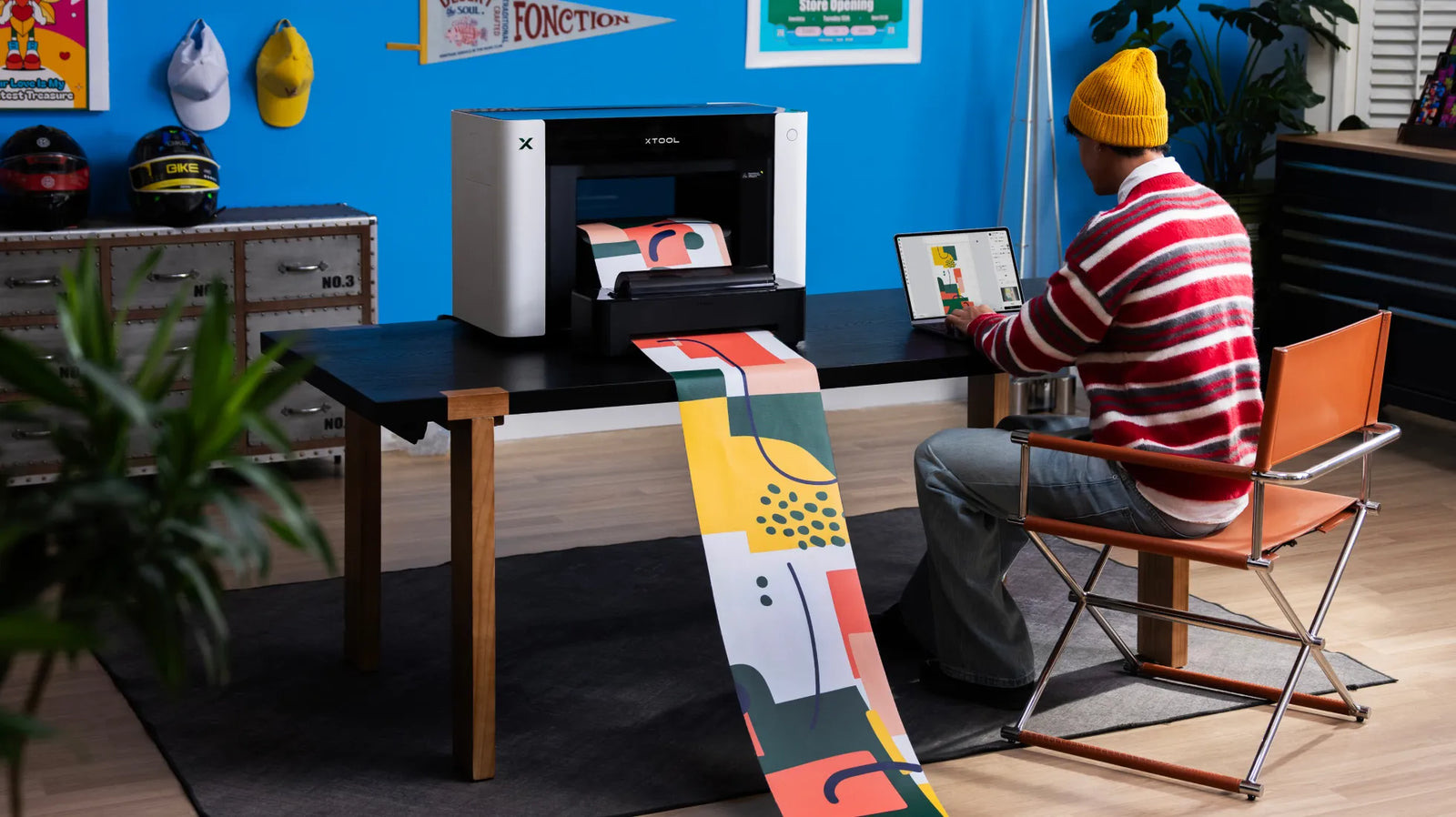
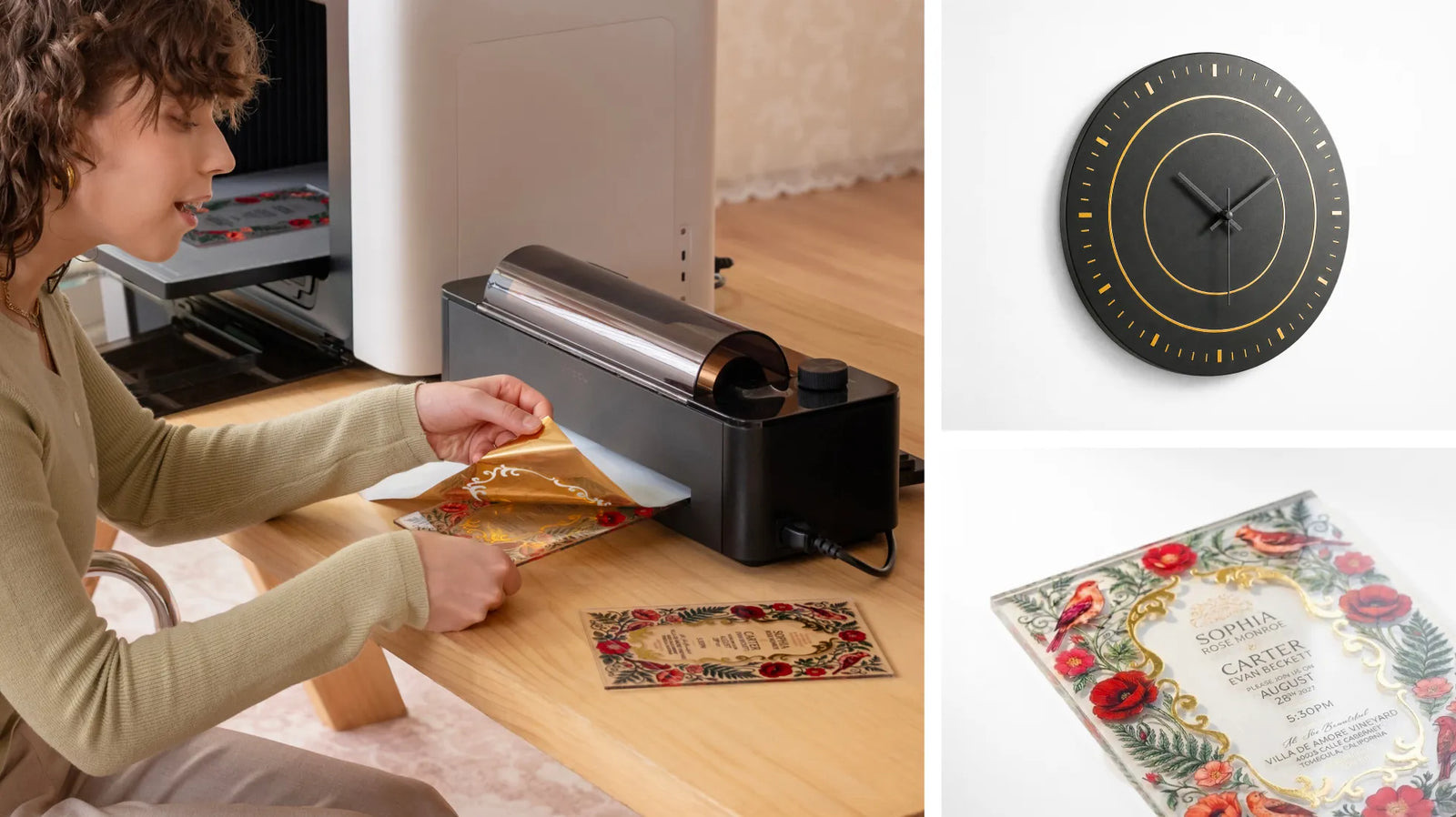
The "4-in-1" in the marketing means four print methods: UV direct-to-object, UV DTF (printing a design onto transfer film), DTG (direct-to-garment), and DTF (direct-to-film for fabric). The editions split exactly where it matters: both UV editions do UV and UV DTF only. Apparel, the DTG and DTF half of the pitch, lives solely in the $2,799 UV + DT Fabric Edition, which is the one with a dedicated fabric print head alongside the UV head. So the cheapest machine that lives up to the "do it all" headline is $2,799, not $1,699.
There's a further limit worth knowing: the UV editions ship with UV heads only, and xTool lists no fabric-head upgrade as of launch. If apparel is anywhere on your roadmap, plan to buy the UV + DT Fabric Edition up front, since adding it later would mean a second machine unless xTool ships a fabric module. If you only ever want rigid UV work (cases, tumblers, signage), the $1,699 entry price is exactly what it looks like, and the edition split doesn't affect you.
What the $1,699 buys, and what every edition shares
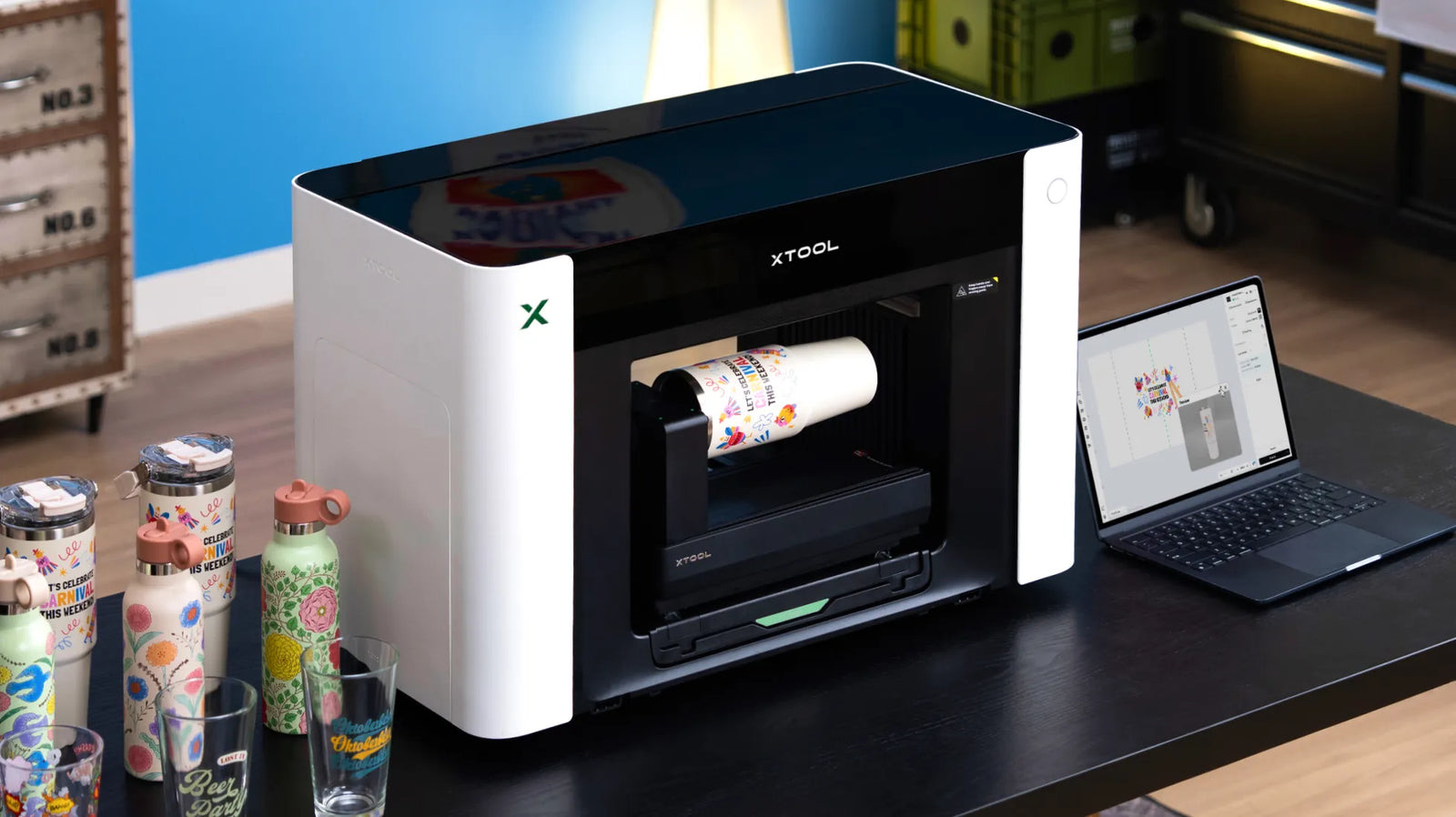
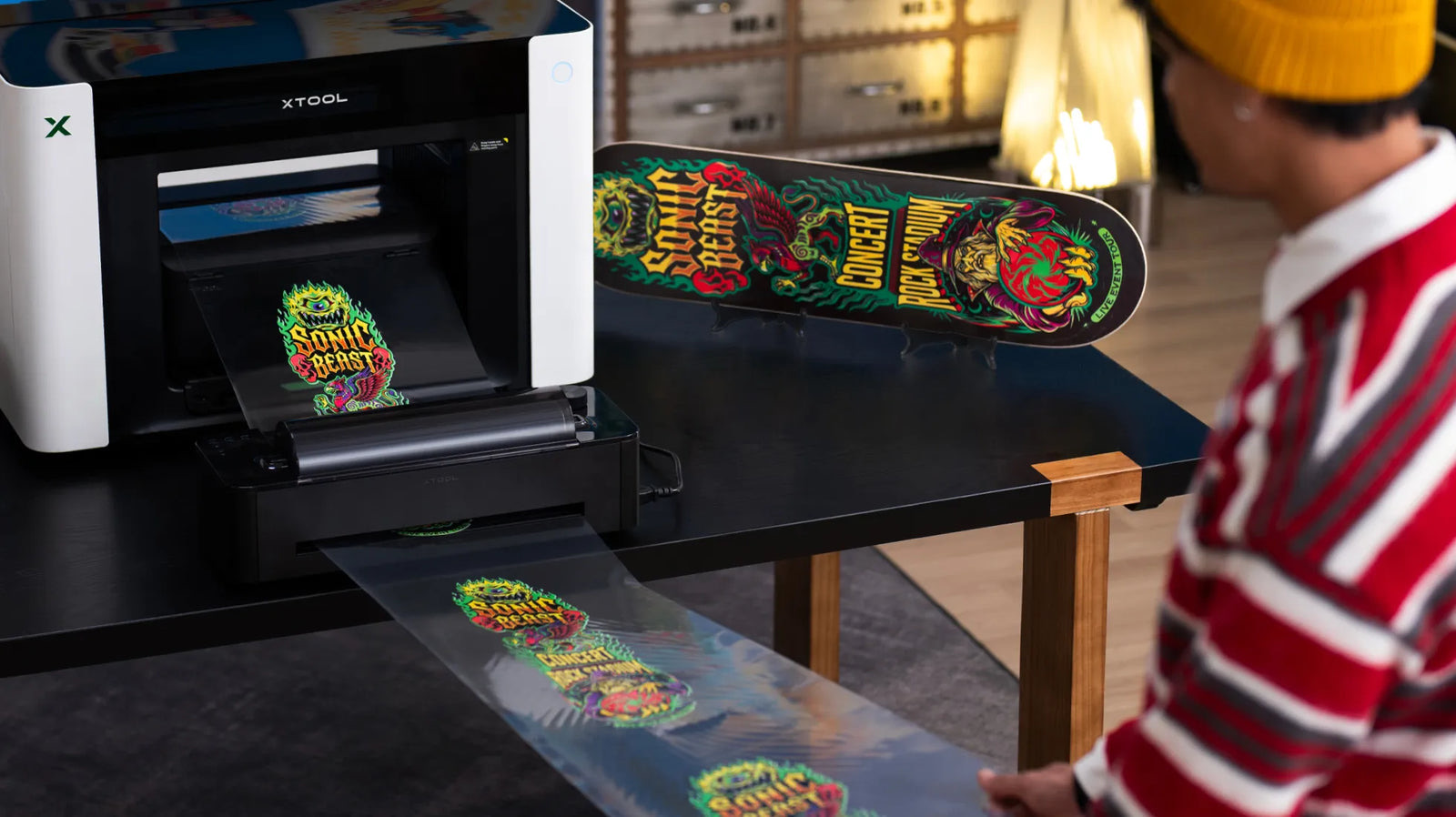
The Single UV Edition is an entry UV flatbed: one Epson F1080 head, CMYK plus white and a varnish channel, printing onto rigid and curved hard goods like acrylic, wood, glass, metal and leather. It doesn't do apparel and it has the slower single head. For a hobbyist personalizing phone cases, coasters and tumblers, it covers the basics. For a shop, it's the entry tier, not the full-capability model.
What doesn't change across the three editions is the part that decides print quality and size:
- Print resolution: 720 x 1440 dpi on all three (from xTool's spec table). Solid for object and texture work, though below the 1440 x 2400 of i3200-class heads like the HeyGears G1X for fine photographic UV.
- Large print bed: 330 x 420 mm (A3+, about 13 x 16.5 in), the same bed size as the eufyMake E1 and the HeyGears G1, plus a smaller 330 x 122 mm standard bed. The Fabric edition adds a 300 x 390 mm DTG platen.
- Raised texture up to 7 mm (0.28 in), built by stacking UV ink and varnish, against 5 mm on the eufyMake E1 and HeyGears G1. Past a millimeter or two of relief that's more a capability ceiling than a quality gain, since each extra millimeter is more ink and time, but it's headroom the rivals don't have.
- Object clearance at least 150 mm, positioning accuracy up to ±0.2 mm, software is xTool Studio.
The Dual-Head UV Edition spends its extra $1,000 on a second UV head (more speed) plus the specialty inks: rigid white, flexible white, and fluorescent red and yellow for blacklight effects. It's the edition for neon effects and higher throughput, but it still doesn't print fabric. Watch the $100 gap to the top tier: the UV + DT Fabric Edition costs only $100 more and adds the entire fabric workflow, so the Dual-Head UV makes sense only if you're sure apparel is off the table and you specifically want the neon inks and second-head speed.
It prints 7 mm of texture, not 3D models
One clarification worth making before you spend $2,799, because the marketing word "3D" invites it: the O1 Omni isn't a 3D printer. It doesn't make freestanding objects. The "3D" is raised, tactile relief, up to 7 mm of stacked UV ink and varnish on top of a flat or curved surface, driven by a texture library in the software. That works for a textured phone case you can feel, but not for a freestanding figurine.
If you actually want printed full-color 3D objects on a desk, that's a different machine: the HeyGears G1X Full-3D Pack at $3,299 in Kickstarter pricing is the only desktop contender, and the industrial answer is a roughly $50,000 Mimaki. The O1 Omni and the eufyMake E1 are both surface printers: they decorate existing objects rather than build new ones.
What the ink actually costs
xTool published its ink prices on the O1 Omni product page, below the spec table. Here's what they mean per liter.
| Ink | Bottle | Launch | MSRP | Per liter (launch) |
|---|---|---|---|---|
| UV ink (C/M/Y/K/W) | 125 ml | $13.99 | $19.99 | ~$112 |
| UV varnish | 125 ml | $15.99 | $22.99 | ~$128 |
| UV fluorescent (yellow/red) | 125 ml | $19.99 | $28.99 | ~$160 |
| UV white (soft/rigid) | 290 ml | $23.99 | $34.99 | ~$83 |
| DT fabric ink (C/M/Y/K) | 125 ml | $12.99 | $18.99 | ~$104 |
| DT fabric white | 290 ml | $21.99 | $31.99 | ~$76 |
Prices from the 'Exclusive Launch Price' vs MSRP ink table on xTool's official O1 Omni page, checked June 29, 2026. Per-liter is calculated from the bottle size. White ships in larger 290 ml bottles because it's the heaviest-used channel: it lays down first as an opaque primer under every color on dark or clear material.
The closest shipping rival, the eufyMake E1, sells its ink in 100 ml cartridges at about $42.99, or roughly $430 per liter. The O1 Omni's standard CMYK or white ink at $13.99 per 125 ml is about $112 per liter at launch, or about $160 at full MSRP, so on paper its ink is roughly a quarter of the E1's at launch and under half at MSRP. Read that as a ceiling, not a promise: it's a bottle-versus-cartridge comparison, not like-for-like, and per-liter isn't per-print. The number that decides cost is ink-per-print (coverage plus cleaning waste), which xTool hasn't published, so the real gap could be smaller.
Two honest counterweights, because per-liter isn't per-print:
- It's a closed, proprietary cartridge system, and xTool says it doesn't support third-party inks. Cheap per-liter today is xTool's price, and you can't escape to bulk third-party ink the way open UV printers allow. The $112 per liter is only cheap as long as xTool keeps it there.
- You still can't compute cost per print. xTool hasn't published how many prints a bottle yields, what a replacement print head costs, or how much ink the cleaning cycles consume. Per-liter ink price times an unknown is still an unknown.
The running costs to budget for
Beyond the machine and ink, a handful of recurring lines decide the O1 Omni's true cost of ownership. Most don't have a published O1 price yet, so budget for them:
- Bottle yield. No prints-per-bottle or ml-per-print figure, so the cheap per-liter ink can't yet become a cost per coaster or per shirt.
- The print head is a wear part with no published price or lifetime. xTool pitches "SmartCycle 2.0" (auto white-ink stirring and circulation, a moisture damper, a 14-day vacation mode) as extending head life, but markets no number of hours, liters or a replacement cost. For scale, the rival eufyMake E1's replacement head lists around $599; treat that as the order of magnitude to expect, not a quote.
- Idle still costs. The standby maintenance runs a pigment-free moisturizing fluid through the fabric path to cut waste, but no consumption rate and no fluid price are published, so idle time isn't free either.
- The air filter is a consumable. The inks are GREENGUARD-certified and the machine has built-in filtration so you can run it in a room without a vent, which is a real cost saving over a separate extractor, but the filter cartridge is a recurring cost with no published interval or price.
- Power draw: unpublished. Likely small next to ink and heads, but unknown.
When these land, the cost per print becomes computable from the same inputs as any print's true cost: material, machine wear, energy, labor, failure. Until then, treat any "pennies per print" figure, from anyone, as an estimate.
xTool O1 Omni vs eufyMake E1 vs HeyGears G1
The desktop UV field now runs from $1,699 to about $4,800, with an industrial Mimaki near $50,000 above it. Here's the verified state of the field, with the editions placed where they actually compete:
| Machine | Price (US) | Fabric (DTG/DTF) | Freestanding 3D | Ships |
|---|---|---|---|---|
| xTool O1 Omni, Single UV | $1,699 early bird | No | No (7 mm relief) | Aug 2026 target |
| xTool O1 Omni, UV + DT Fabric | $2,799 early bird | Yes (DTG + DTF) | No (7 mm relief) | Aug 2026 target |
| eufyMake E1 (Basic / Deluxe) | $2,499 / $3,299 | UV-DTF film only | No (5 mm relief) | Now |
| HeyGears G1 Starter | $1,699 VIP | DTF via attachment | No (5 mm relief) | Kickstarter, 2026 |
| HeyGears G1X Full-3D | $3,299 VIP | DTF via attachment | Yes, to 130-150 mm | Kickstarter, 2026 |
| OMTech Spectra A3+ | $3,200-4,800 | No | No (5 mm relief) | Now |
| Mimaki 3DUJ-2207 | ~$50,000 | No | Yes (industrial) | Now |
Prices checked June 29, 2026. eufyMake E1 is the official list (Basic $2,499, often discounted to ~$2,299; Deluxe $3,299), shipping now. HeyGears figures are Kickstarter VIP pricing (MSRP higher); the G1 line is the only desktop rival that makes freestanding full-color 3D models, via the G1X Full-3D Pack. OMTech Spectra A3+ is rigid-UV only. Mimaki 3DUJ-2207 is ~$42,078 plus ~$7,000 install (about $50,000). xTool O1 Omni prices are deposit-locked early birds; it ships from August 2026 at the earliest.
Three reads from that table:
- On UV texture work, the O1 Omni undercuts the E1 at launch pricing. The Single UV at $1,699 early bird is about $800 under the E1 Basic at $2,499, but that gap is the launch promo: at its own $2,499 MSRP the Single UV ties the E1 Basic, so today's edge is the discount, not the hardware. The Dual-Head UV at $2,699 sits below the E1 Deluxe at $3,299. The E1 ships today with a year of reviews and final consumable prices, while the O1 Omni ships in August at the earliest.
- On the full 4-in-1 combo, the O1 Omni has no direct rival under $3,000. Nothing else at $2,799 does UV, UV DTF, DTG and DTF in one box. The E1 prints UV-DTF transfer film but not direct-to-garment on cotton; the OMTech is rigid-only; the HeyGears line is priced and built as a 3D machine.
- For freestanding 3D, the O1 Omni isn't an option, because it does none. If you want printed 3D objects rather than raised texture, the HeyGears G1X at $3,299 VIP or the industrial Mimaki are the machines, not this one.
Which edition, and should you wait
Match the edition to the work, not the headline:
- Rigid UV only (phone cases, tumblers, coasters, signage): the Single UV at $1,699 is the honest entry, and the edition split doesn't affect you.
- More speed plus neon and white-ink effects, still no apparel: the Dual-Head UV at $2,699, but only if you're sure apparel is off the table, since the fabric edition is just $100 more.
- Anything with apparel (DTG or DTF): the UV + DT Fabric at $2,799, bought up front, because xTool lists no way to add the fabric head later.
- Need a machine this summer: buy the shipping eufyMake E1 instead; the O1 Omni ships in August 2026 at the earliest.
The one number that should gate a real purchase is still unpublished: ink-per-print yield, and the printhead replacement price behind it. Until those land, the refundable $50 deposit is the cheap way to hold the early-bird price without committing.
How the $50 deposit works
- Pay a $50 deposit (EUR 50 in Europe) on xTool's site during the deposit phase (June 29 to July 15, 2026). It's fully refundable any time before you complete the order, and it's deducted from the final machine price, so it's not an extra fee.
- The deposit locks the early-bird price and unlocks a $459 bonus bundle (EUR 455 in Europe): a BatchFlow batch-alignment jig, three 20%-off ink coupons, and 3,000 Atomm design credits. The bundle disappears at launch.
- Pay the balance at the final-payment launch on July 15, 2026. xTool's campaign page says units ship "as early as August 2026," but the press release commits only to that July 15 date, so treat August as a target. After July 15, expect prices at or near MSRP unless xTool extends the early bird.
The usual pre-order caution applies. This is effectively a crowd-launch: deposit, then final payment, then a soft ship window with no guaranteed delivery date and a "specs may change before mass production" line in the fine print. xTool is an established laser and UV brand, not a first-time Kickstarter, which lowers the vaporware risk, but the calendar risk is real and the $50 is refundable precisely so you can wait and watch.
What's still unknown
The open questions that decide this machine's real economics, in the order they should resolve:
- Bottle yield: prints per bottle, or ml per print, so cost per print becomes computable
- Print head replacement price and rated lifetime
- Cleaning-cycle and standby fluid consumption, and the air-filter price and interval
- EUR MSRPs (launch prices of 1,549 to 2,549 EUR are now official on xtool.eu; the post-launch EUR prices aren't)
- Real ship dates after July 15, and the first tests of production units (Berlin demo units showed teething troubles on early software)
A $50 refundable deposit is a cheap way to hold a place while those publish. A purchase decision needs lines 1 and 2. This page updates when they land.
Frequently asked questions
How much does the xTool O1 Omni cost?
Three editions, in early-bird pre-order pricing as of July 4, 2026: Single UV $1,699, Dual-Head UV $2,699, and UV + DT Fabric $2,799. After launch the MSRPs are $2,499, $3,299 and $3,499. Official EU launch prices are 1,549, 2,499 and 2,549 EUR at a 20% VAT reference rate, adjusted at checkout. A $50 (EUR 50) refundable deposit, deducted from the final price, locks the early-bird rate ahead of the July 15, 2026 final-payment date.
Can you finance the xTool O1 Omni?
Yes. At launch xTool's checkout advertised monthly financing from about $83 (Single UV) to $136 (UV + DT Fabric) over 24 months, but the actual payment is set by the lender and your credit, so treat those as starting estimates. The $50 deposit is separate and refundable.
Can the $1,699 xTool O1 Omni print on T-shirts?
No. The $1,699 Single UV Edition and the $2,699 Dual-Head UV Edition print on rigid and curved hard goods (UV and UV DTF) only. Direct-to-garment (DTG) and direct-to-film (DTF) for apparel require the $2,799 UV + DT Fabric Edition, which has the dedicated fabric head the UV editions lack, and xTool lists no way to add it to them later. If you want to print shirts, buy the fabric edition up front.
What is the difference between the three O1 Omni editions?
Print heads and inks. The Single UV ($1,699) has one UV head. The Dual-Head UV ($2,699) adds a second UV head for speed plus neon/fluorescent and soft/rigid white inks. The UV + DT Fabric ($2,799) pairs a UV head with a dedicated fabric head for DTG and DTF apparel. All three share the 720 x 1440 dpi resolution, the 330 x 420 mm bed, and 7 mm of raised texture.
What does '4-in-1' mean on the xTool O1 Omni?
The four are print methods, not machines: UV direct-to-object (onto rigid goods like wood, acrylic and tumblers), UV DTF (printing a design onto transfer film), DTG (direct-to-garment, onto cotton apparel), and DTF (direct-to-film for fabric). All four together only come on the $2,799 UV + DT Fabric Edition; the two cheaper UV editions do the first two.
Is the xTool O1 Omni a 3D printer?
No. It's a UV, DTG and DTF printer that decorates existing objects and fabric. Its '3D' is raised, tactile texture up to 7 mm of stacked UV ink and varnish on a surface, not a freestanding 3D model. For full-color 3D objects on a desk, the HeyGears G1X Full-3D Pack ($3,299 VIP) is the only desktop option as of June 2026.
How much does xTool O1 Omni ink cost?
From xTool's own product page (June 29, 2026): standard UV CMYK or white ink is $13.99 per 125 ml at launch ($19.99 MSRP), about $112 per liter. UV varnish is $15.99, fluorescent inks $19.99, and high-capacity 290 ml white is $23.99. That's roughly a quarter of the eufyMake E1's ~$430 per liter, though cost per print depends on bottle yield, which xTool hasn't published.
Is the xTool O1 Omni better than the eufyMake E1?
On price for UV texture work, yes: the Single UV ($1,699) undercuts the E1 Basic ($2,499) by about $800 and gives 7 mm of relief against the E1's 5 mm, and the O1 Omni's ink is far cheaper per liter. The E1's edge is that it ships today with a year of reviews and known consumable costs, while the O1 Omni ships in August 2026 at the earliest. Need a machine this summer: the E1. Want more capability per dollar and can wait: the O1 Omni's $50 deposit is refundable, so reserving one costs nothing if you change your mind.
When does the xTool O1 Omni ship?
Pre-orders (the deposit phase) opened June 29, 2026, final payment is July 15, 2026, and xTool's campaign page says units ship 'as early as August 2026.' There's no firm release or general-availability date beyond that August target. The press release commits only to the July 15 date, and the fine print notes specs may change before mass production, so treat August as a target, not a guarantee.
Is the xTool O1 Omni deposit refundable?
Yes. The $50 deposit (EUR 50 in Europe) is fully refundable any time before you complete the order, and it's deducted from the final machine price rather than added on top. Paying it also locks the early-bird price and unlocks a $459 bonus bundle (BatchFlow jig, three 20%-off ink coupons, 3,000 Atomm credits) that disappears at the July 15 launch.
Sources & methodology
- xTool O1 Omni official product page: editions, full spec table (720 x 1440 dpi, 330 x 420 mm bed, 7 mm relief, Epson F1080 heads), ink price table, deposit and bonus mechanics
- xTool O1 Omni deposit / privilege voucher page: $50 deposit, $459 bonus contents
- xTool EU page: official EUR launch prices (1,549 / 2,499 / 2,549 EUR at 20% VAT reference), EUR ink table, EUR 50 deposit, EUR 455 gift bundle
- xTool press release (PRNewswire): three editions with MSRP, June 29 deposit phase, July 15 final-payment launch, 4-in-1 claim
- eufyMake E1: official price (Basic $2,499 / Deluxe $3,299) and ink cartridges
- OMTech Spectra A3+ desktop UV flatbed: official pricing
- HeyGears G1 / G1X verified pricing and full-color-3D capability, plus the Mimaki 3DUJ-2207 (~$50k) benchmark: our running tracker
- Images: xTool official O1 Omni product media
Share this article
Related articles
Printers · Jul 4, 2026
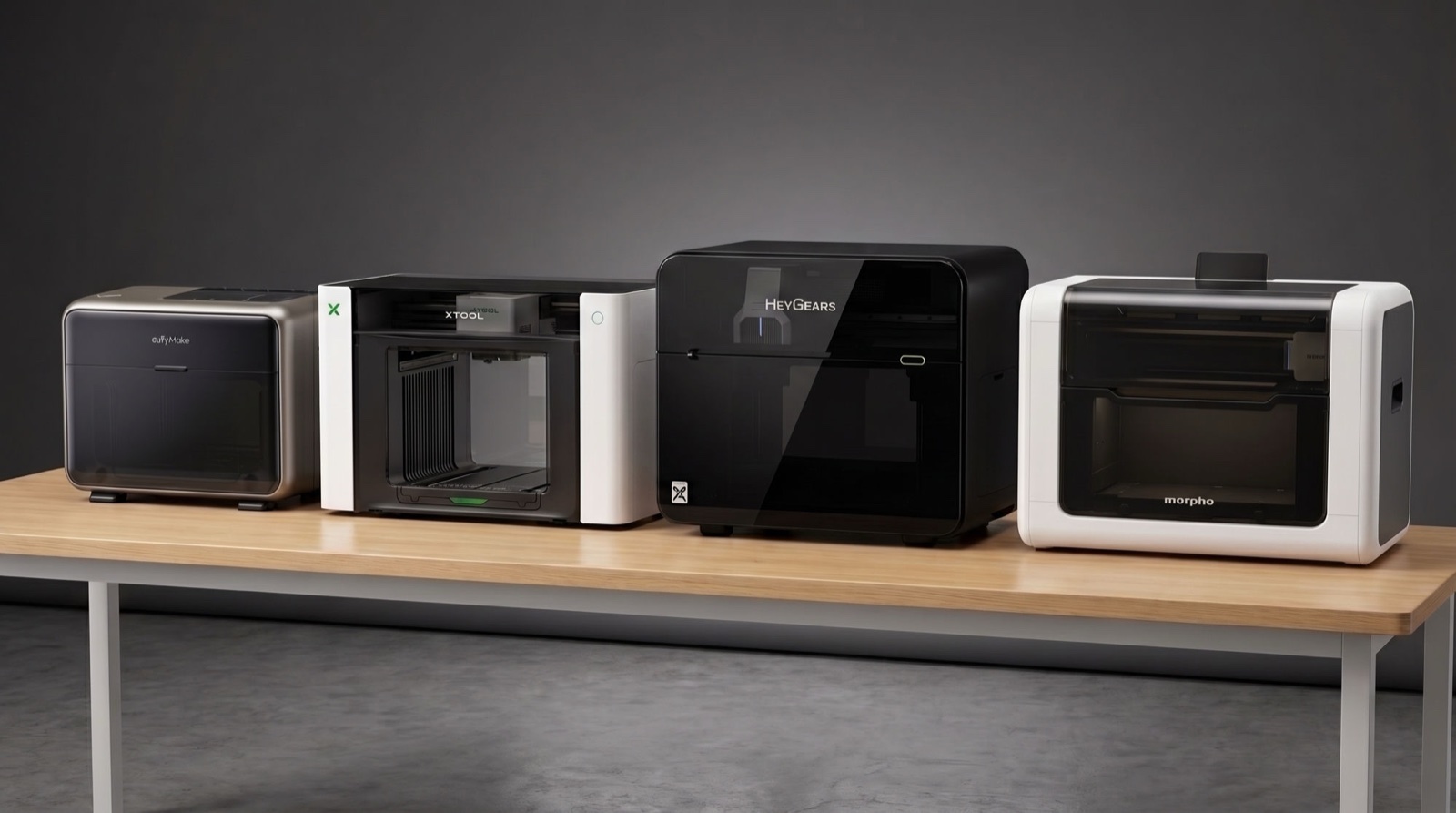
The Best Desktop UV Printer in 2026: Every Machine Compared
Desktop UV printers now share the same desk, from $1,599 to $9,299. The field moved again this month: eufyMake cut its ink prices about 30%, and four challengers are heading for launch. Here is the whole sub-$10,000 field as of July 2026: what each machine prints, what the ink costs per liter, and which one fits which kind of work.
27 min read
Printers · Jul 2, 2026
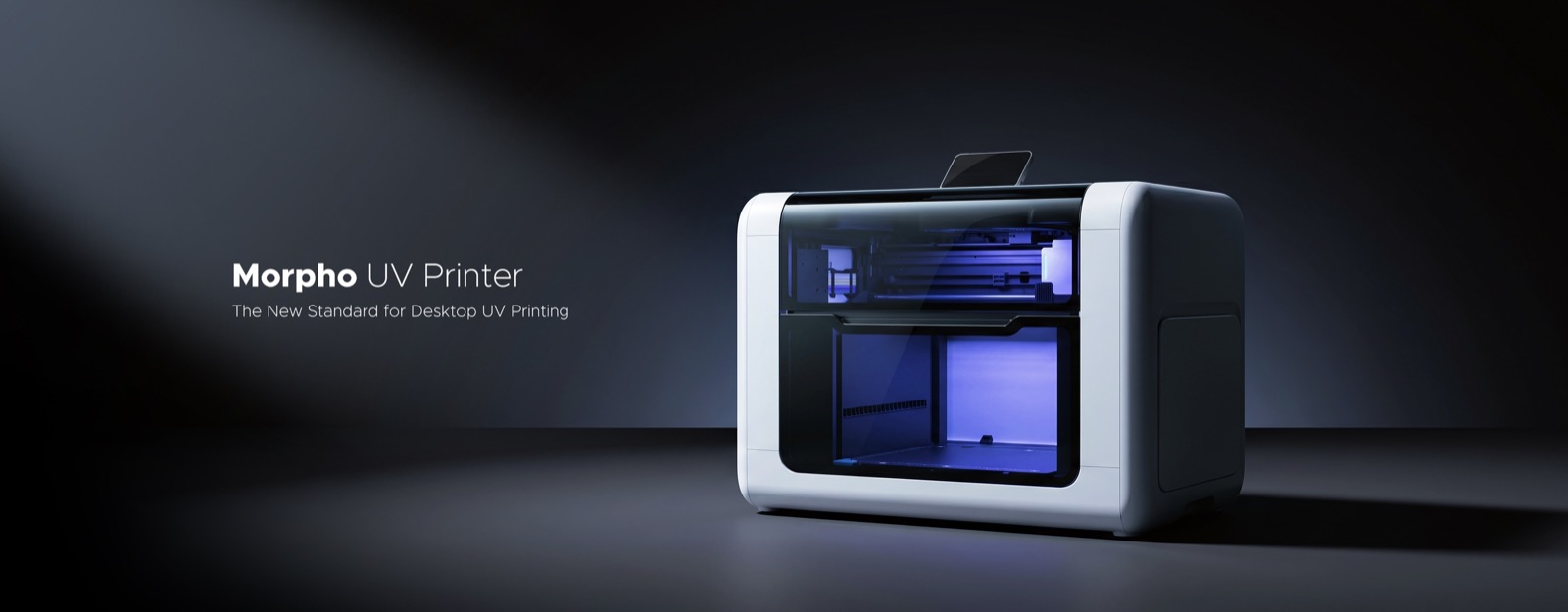
Morpho UV Printer: Prices, Both Models, and Specs
DJI's former camera chief just announced a desktop UV printer with an enclosed moving-gantry design, stereo vision alignment, an open ink system, and up to 60 mm of stacked texture, starting at $1,599. Here's every spec, what separates the two models, and how the deposit and cashback work ahead of the Kickstarter.
24 min read
Printers · Jun 12, 2026
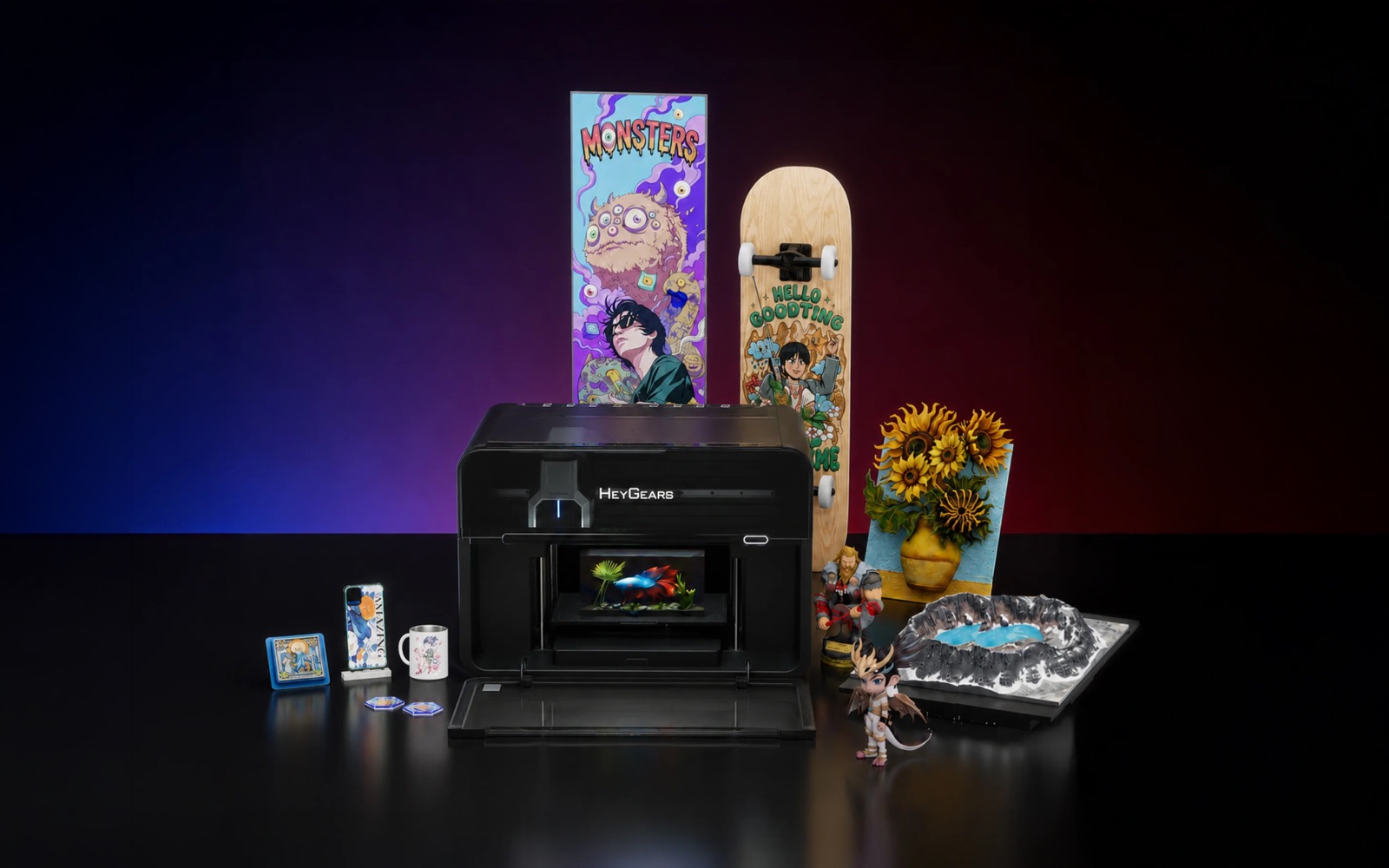
HeyGears G1 and G1X: Full-Color 3D Printing Gets a Desktop Price
Full-color 3D printing used to mean a $50,000 machine. HeyGears put it on a desk for $3,299. The three tiers print very different things, and HeyGears has now published the ink, resin and printhead numbers that decide the real cost of ownership. Here's every price, what each pack buys, and what it costs to run.
18 min read